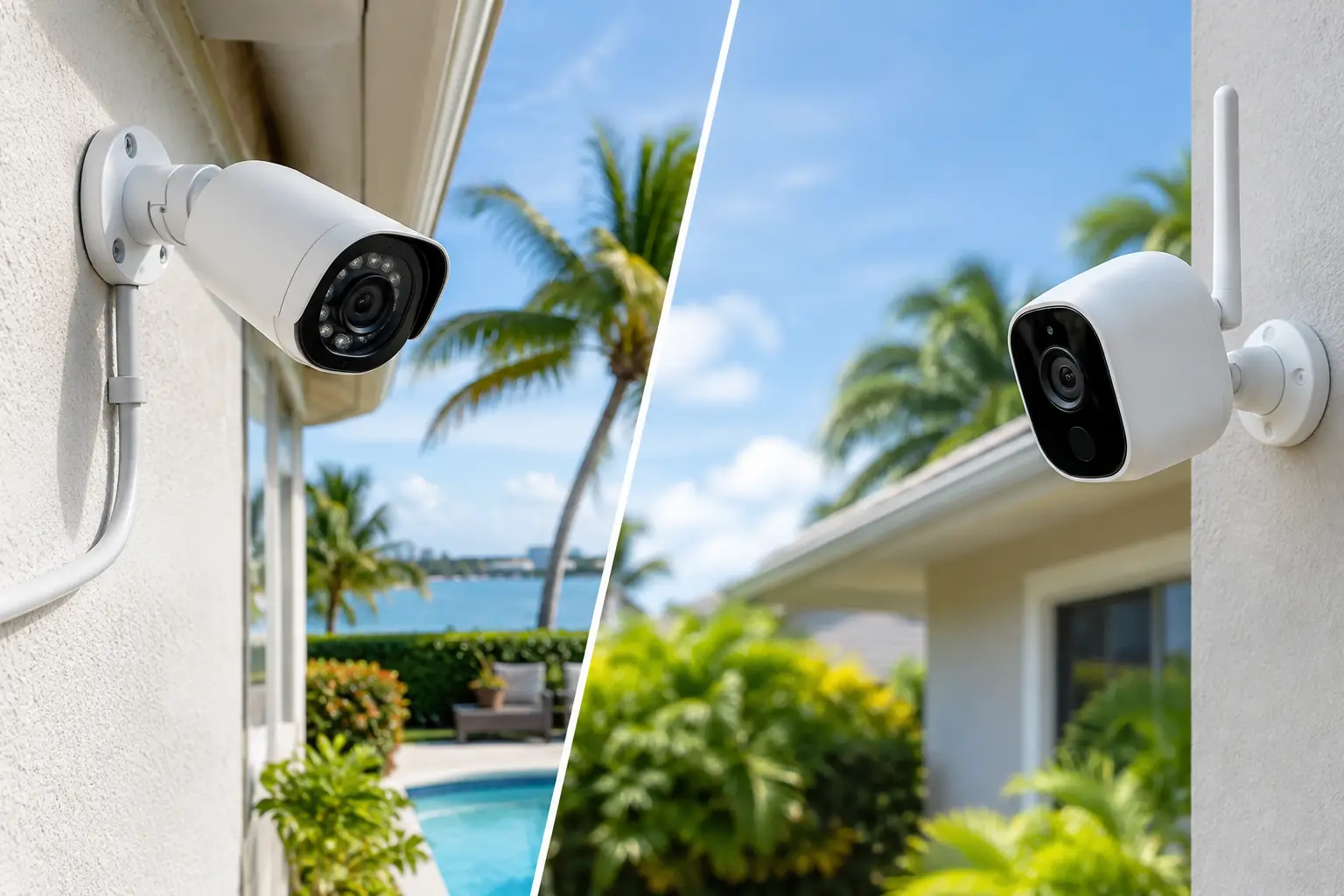
A camera that drops offline when you are in Ohio, New York, or overseas is not much help when someone is standing at your Naples home. That is the real question behind wired versus wireless security cameras: not which option sounds more modern, but which one will keep working when you need a clear answer about what is happening at your property.
For many Southwest Florida homeowners, the right answer is a mix of both. A professionally wired camera system can protect the perimeter and critical entry points, while a wireless camera may make sense for a gate, detached garage, or location where running cable would be disruptive. The best choice depends on the property, the existing wiring, your internet reliability, and how you plan to use the footage.
Wired Versus Wireless Security Cameras: The Core Difference
A wired security camera is connected to the system by cable. In most newer professional systems, one Ethernet cable provides both power and data through Power over Ethernet, often called PoE. The camera records to a local network video recorder, and the system can still be viewed remotely through an app when internet service is available.
A wireless camera sends video over WiFi. Many wireless models still need a nearby electrical outlet, so “wireless” usually means wireless data, not a camera with no wires at all. Battery-powered cameras are an option as well, but they require charging or battery changes and are generally better suited to selective coverage than full-time property protection.
This distinction matters because video is demanding. A high-resolution camera must send a large, steady stream of data. WiFi can handle that well in the right location, but it is more susceptible to distance, building materials, network traffic, weak signal areas, and router problems.
Why Wired Cameras Are Often the Better Long-Term Investment
For a primary residence, second home, or vacation property with meaningful exterior coverage needs, wired cameras usually provide the most dependable foundation. They are built for continuous recording, stable image quality, and less hands-on maintenance.
Reliability without depending on WiFi at every camera
A PoE camera does not need to compete with phones, streaming TVs, smart appliances, and guests’ devices for wireless bandwidth. Once the camera is connected to the recorder, it has a dedicated physical path for power and video. That is particularly valuable for cameras covering driveways, pool areas, front doors, rear lanai doors, and side-yard access.
Florida construction can make WiFi coverage less predictable than homeowners expect. Concrete block walls, stucco, metal screens, tile roofs, and distance to an outdoor camera can all weaken a signal. A camera may appear to work during setup, then become inconsistent during heavy network use or after a router change.
Continuous recording and stronger evidence
Many wireless and battery-powered cameras record only when motion is detected. That can be useful, but it can also miss the few seconds leading up to an event or fail to capture activity that does not trigger motion properly.
Wired systems are commonly configured for around-the-clock recording. If a vehicle enters the driveway, a delivery is misplaced, or a contractor arrives outside the expected time, there is a fuller record to review. Continuous video is often more useful than a short motion clip when trying to understand what actually happened.
Less routine maintenance
A properly installed wired camera does not need batteries swapped, removed for charging, or repositioned after a battery door is opened. The recorder can store footage locally, avoiding a camera-by-camera dependence on cloud plans. Equipment still needs occasional attention, especially after storms or electrical events, but the day-to-day workload is lower.
For seasonal residents, that reduced upkeep is a major benefit. You should be able to check your home remotely without wondering whether the back-yard camera needs a charge.
Better fit for larger camera systems
When a property needs four, six, eight, or more cameras, WiFi can become a poor place to cut corners. Multiple cameras constantly sending high-resolution video can strain a consumer-grade network. Wired infrastructure is more scalable and usually easier to troubleshoot because each camera has a known cable run and connection point.
A wired installation also keeps security video separate from the household WiFi experience. Your family, guests, and renters can use the internet without their activity interfering with the cameras that protect the property.
Where Wireless Cameras Make Sense
Wireless cameras are not automatically inferior. They can be a practical choice when their limitations match the job.
A single camera at a front entry, a temporary view of a construction project, or coverage inside a detached space may be easier to handle with WiFi. They can also be useful where accessing walls and ceilings to run cable would require significant repair work. For homeowners who want a straightforward app experience and a few cameras rather than a full surveillance system, wireless equipment can provide a sensible starting point.
Wireless cameras also work well when the WiFi network is designed for them. Adding professionally placed access points can solve weak-signal areas that a standard router cannot reach. Still, good WiFi does not eliminate the need to plan for power, video storage, account access, and internet outages.
Battery cameras deserve extra caution around high-traffic entry points. Heat, frequent alerts, and repeated live viewing can reduce battery life quickly. A battery camera may be convenient at a remote gate or mailbox, but it is rarely the best sole camera protecting the main entrance to an unoccupied home.
The Hidden Costs to Consider Before Choosing
The initial price of a wireless camera can look attractive, especially when comparing one retail camera with a professionally installed wired system. That comparison often leaves out recurring subscriptions, batteries, signal extenders, replacement equipment, and time spent diagnosing a camera that has gone offline.
Wired systems generally cost more at installation because cable must be routed properly, cameras must be mounted securely, and the recorder needs a protected location. However, the infrastructure can serve the home for years. If the cabling is installed correctly, upgrading to newer cameras later may be far simpler than starting over.
Storage is another point homeowners should ask about directly. Cloud storage is convenient for short clips, but fees can grow with each added camera. A local recorder gives you control over retention time and can keep recording even if the internet goes down. Remote viewing will not work during an internet outage, but the cameras may continue capturing video locally as long as the equipment has power.
For coastal and storm-prone properties, power planning also matters. A battery backup for the recorder, network equipment, and internet gateway can keep a wired system operating through a short outage. No camera system can guarantee remote access during a prolonged outage or damaged internet infrastructure, but a properly designed system gives you a better chance of retaining video when conditions are less than ideal.
Start with the Coverage Plan, Not the Camera Box
The better question is not simply whether a camera is wired or wireless. It is what you need to see, how long you need to retain it, and how dependable that view must be.
Start with the areas that would create the biggest concern if you could not check them remotely. For many homes, that means the front entry, driveway, garage doors, pool access, rear doors, and any place vendors or renters enter. Then consider whether you need faces, license plates, broad activity coverage, or all three. One camera rarely does every job well.
Camera placement matters more than marketing claims about resolution. A camera mounted too high may show that someone was present but not provide a useful face image. A wide-angle camera can cover a large area but may not identify details at a distance. A technician-led estimate should address viewing angles, lighting, cable paths, recording needs, and existing equipment before recommending a system.
If your home already has coaxial camera cable or compatible infrastructure, do not assume it all needs to be replaced. Functional wiring and equipment can sometimes be reused or upgraded strategically. That approach can reduce unnecessary cost while improving the parts of the system that are actually holding you back.
A Practical Choice for Southwest Florida Homes
Choose wired cameras when you want continuous recording, dependable perimeter coverage, multiple exterior cameras, and lower long-term maintenance. They are usually the strongest option for second homes, larger properties, and vacation rentals where missed footage can become a real problem.
Choose wireless cameras when you need limited coverage, installation flexibility, or a camera in a location where cable routing is not practical. Just make sure the WiFi signal is genuinely strong where the camera will live, and understand whether it needs outlet power, batteries, or a monthly storage plan.
For many properties, a hybrid setup is the honest answer. Put wired cameras on the entrances and outdoor areas that matter most, then use wireless equipment for the occasional hard-to-reach location. Vigilant Security can assess the property, existing wiring, and remote-access needs without pushing a one-size-fits-all package.
The right camera system should make it easier to leave town, not give you another device to worry about. A clear plan, dependable installation, and someone local who can service the system make all the difference when your property is miles away.
Leave a Reply